The install crew your shop can build on.
Put your install volume on one subcontractor who does nothing but set cabinets — clean, on-schedule installs, and we stay out of your client relationship. You keep the client. We handle the install.
The Problem
Your client judges the whole set on the install.
- An in-house install crew is a second business bolted onto the shop. You hire the guys, train them, and then you own the problem of keeping them working when the floor slows down.
- One installer quits in the middle of the season and finished sets sit in the shop with nowhere to go. Your floor backs up behind them.
- A rushed install can wreck a set you spent weeks building, and the callback comes back to the shop that sold it.
- Install volume swings from week to week. A fixed crew costs you the same whether there's a set to hang or not, and it still isn't enough hands when three jobs land at once.
How We Work With Shops
A subcontractor, not a competitor.
Your install crew, without the payroll
Put your install volume on one crew that only does this. There's no payroll to carry when the floor's slow, and nobody to replace when an installer walks off.
You keep the client
We deal with you, not your customer. We stay out of your relationship with the client and never try to build our own, so they deal with you start to finish. We set the cabinets and leave.
Installs that protect your reputation
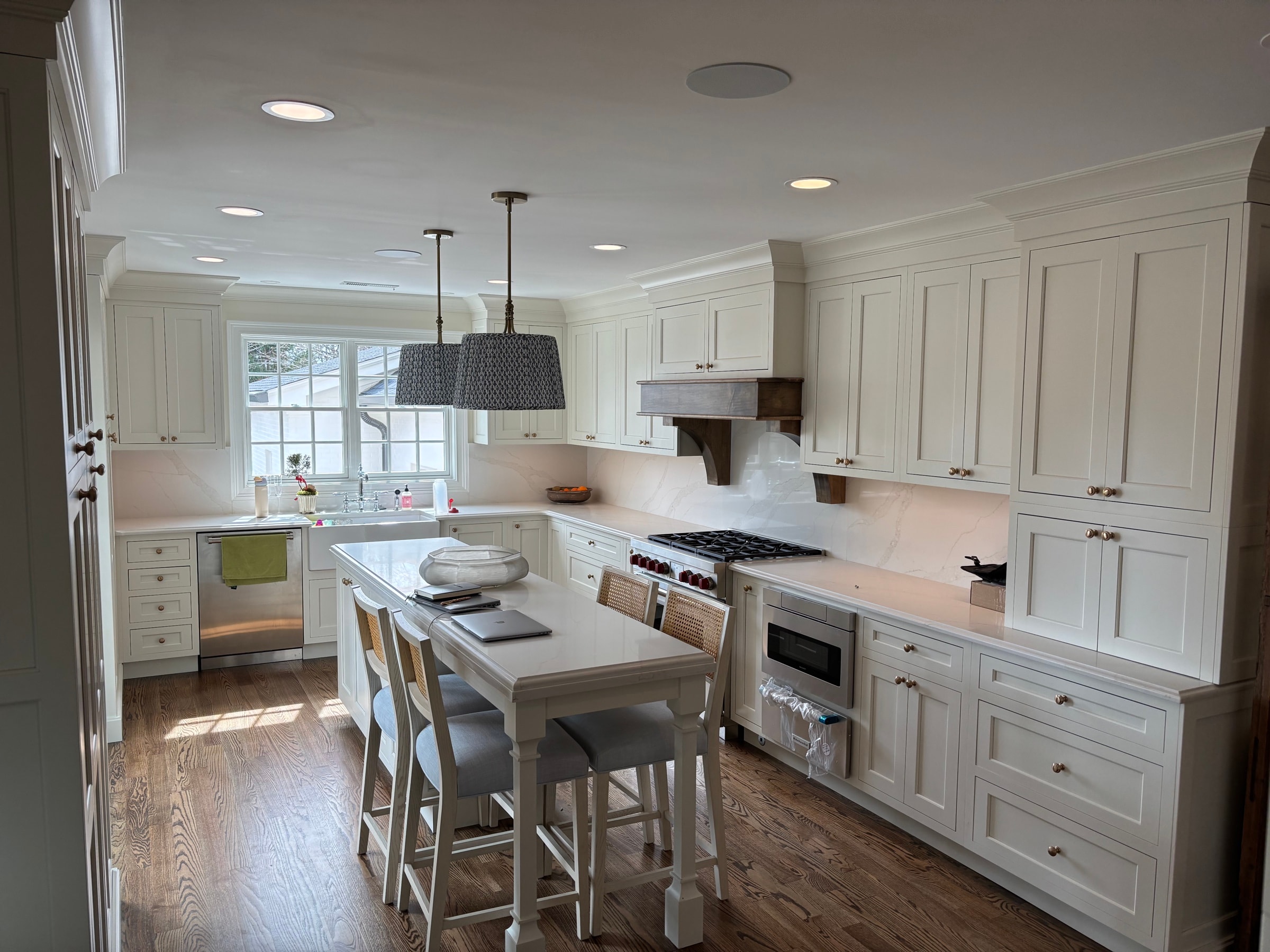
We set every run level and plumb, scribe it tight to the wall, and shim it so it stays that way. The kitchen the client walks matches the drawing you sold them.
Scheduling you can plan around
We give you an install window and show up for it. You'll hear from us while the job's running, so you can hand your client a delivery date and hold it.
Scales with your season
We take as much or as little as you've got. In the slow weeks you're not paying a crew to stand around waiting for the next set to build.
The finish work, not just the boxes
Cabinets are finish carpentry. The same crew that sets the boxes scribes the panels, cuts the fillers, and runs the crown and light rail on top. You get the whole thing done without lining up a second trade.
In Detail
What a clean cabinet install actually takes.
The client never sees the joinery in your boxes or the inside of your finish booth. What they see is whether the doors line up, whether the crown returns tight, and whether the run sits level against a wall that isn't. All of that happens at the install, and a bad one can undo weeks of good shop work. That's why it's worth putting the set in the hands of a crew that does only this.
No floor is flat and no wall is plumb
We shoot the room with a laser and find the high point of the floor, because that's where the cabinet elevations have to start. Set a base run down in a low corner and every door and drawer above it fights you the rest of the job. Uppers hang to a level line off that same reference, since the ceiling is no straighter than the floor. Shims go where they actually carry weight, and they get cut back so nothing shows once the toe kick and scribe cover them.
Scribes, fillers, and keeping the reveals even
Walls are never straight, so the cabinets have to be cut to them. We scribe the end panels and fillers to the wall and back-cut the edge so it closes tight without a fat bead of caulk holding it together. We plan the filler widths so the gap at the wall matches the gap between the doors, because when those reveals don't line up a run looks off even if the client can't tell you why. Crown and light rail get cut at 45s and glued at the corners so the returns stay closed, and a finished end gets a finished panel instead of a bare box side.
Keeping your boxes clean from the truck to the punch list
Your boxes leave the shop clean, and our job is to keep them that way through the install. We stage them so finished faces aren't leaning against grit, hang the doors and set the drawers so nothing rubs, and adjust every hinge and slide until the run opens and closes even. We leave the kitchen swept with a short punch list. If something needs to come back to the shop, you hear about it from us before the client does.
Why a dedicated sub beats a crew on your payroll
An in-house install crew only pays for itself when it's booked solid. The weeks it isn't, you're covering wages for guys with no set to hang; the weeks you're slammed, you're short-handed and rushing the one step the client actually judges you on. A dedicated finish sub turns that fixed payroll into a cost you only pay when there's work, and it leaves your floor free to keep building cabinets. See what a full cabinet installation covers, or how we handle built-ins and integrated millwork. If you're weighing box lines for a project, there's also our take on RTA vs. semi-custom vs. custom cabinets.
Why shops trust us
Your name goes on it. So does our standard.
Trim and finish carpentry is all we do, so your cabinet job never gets the B-team. Most shops come to us because the last installer wasn’t up to snuff or left them short in the middle of a season, so we know the trust has to be earned before it’s handed over. We’re a legitimate business that runs on a set process, not a crew you found on the internet, and we earn it on the first few sets by showing up when we said and setting the runs clean. It’s your name on the finished kitchen, so we set every run to the standard we’d want on our own work. Once a shop sees that hold up set after set, they stop looking for an installer and just send us the next one.
Questions
What shops ask first.
Get us on your install roster.
Tell us about your install volume and how you like to run a delivery. We'll walk you through exactly how we'd fit into it, staying out of your client relationship and working on your schedule.